
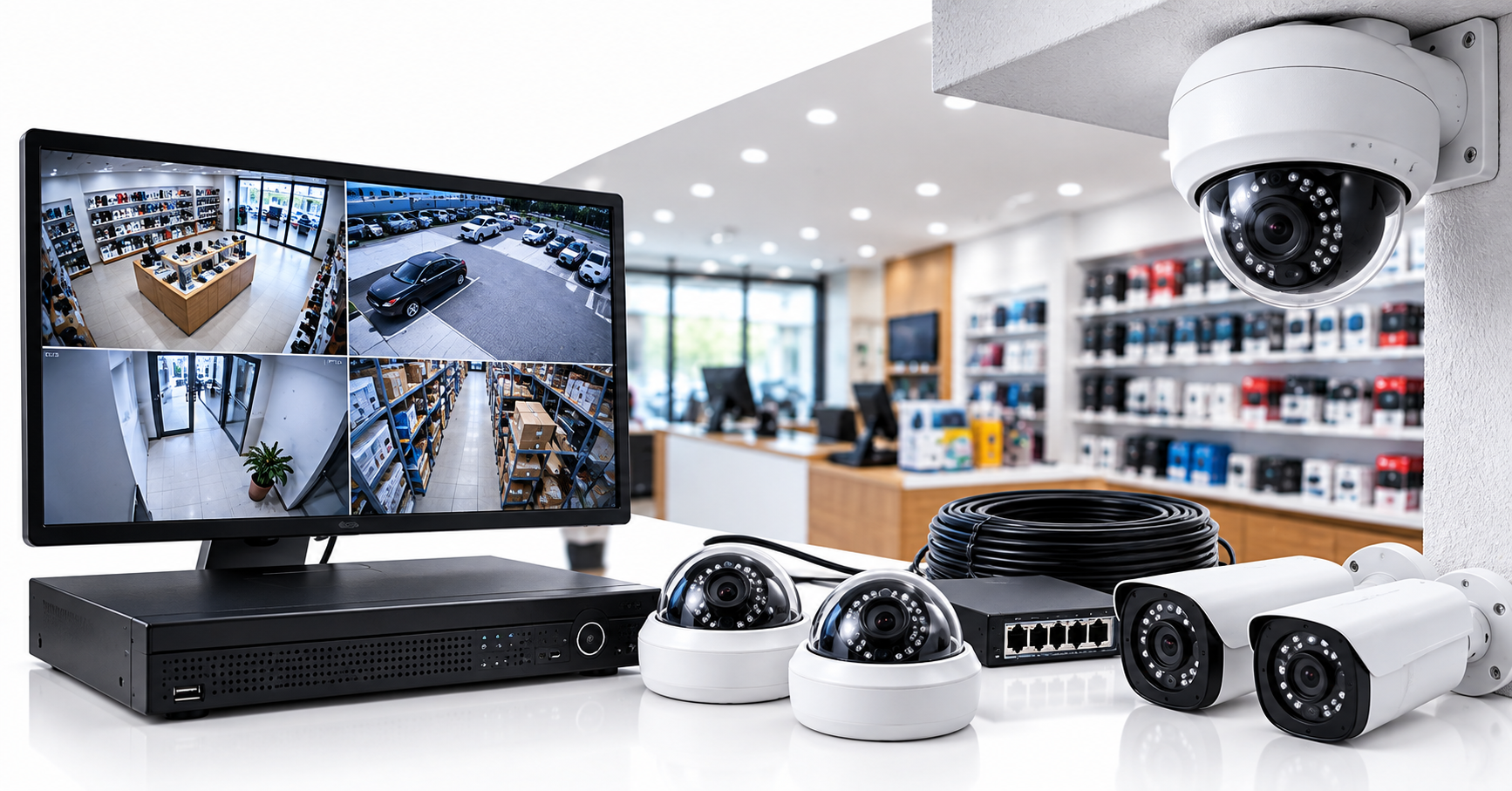
Most CCTV quotes go wrong before anyone picks a camera. The owner asks for "a package" instead of walking the shop first and deciding what needs watching. Get that part right and the rest of the spec follows. Here's what to work through before you request a quote.
Start with what you're trying to see, not what camera to buy
Entry and exit points, the till, the stockroom, the whole shop floor: each of these calls for different placement and often a different camera type. A wide-angle camera covering the floor needs a different lens and resolution than a close-up camera aimed squarely at a till. Decide the goal before the hardware.
Camera count follows your layout, not a package size
Walk your own premises and note every point you need visibility on: entrances, exits, cash points, stock areas, blind corners. A small shop with one entrance and a till might need only 2-4 cameras. A larger office or multi-room premises needs more. Resist buying a fixed "package" before you've done this walk; a system sized to someone else's shop is rarely sized correctly for yours.
Resolution is a tradeoff, not a spec to maximise
Higher resolution gives clearer footage, useful for identifying faces or number plates, but eats more storage. General area monitoring rarely needs top-tier resolution; a till or entrance where you need to identify individuals clearly is where it earns its cost. Worth discussing camera by camera with whoever installs your system, based on what each one is watching.
Analogue or IP: neither wins outright
Analogue systems (HD-CVI/TVI/AHD) run over coaxial cable to a DVR: simpler, often more affordable, and proven technology. IP cameras run digital video over network cabling or Wi-Fi to an NVR, and typically support higher resolutions plus more flexible remote viewing over the internet. The right call depends on your building's existing cabling, your budget, and whether checking your shop from your phone matters to you.
Placement beats camera count
Two shops with identical camera counts can end up with very different coverage. Cameras mounted too high or too far from an entrance often miss usable facial detail even at good resolution. Cameras near bright windows or doorways can wash out from glare or backlighting during the day. A good installer walks the space, checks lighting at different times of day, and positions cameras around your actual monitoring goals, not in generic, evenly-spaced rows.
Storage is the tradeoff nobody budgets for upfront
Footage sits on the DVR/NVR's hard drive, and how many days you can retain depends on three things at once: camera count, resolution, and drive size. More cameras and higher resolution both eat storage faster, which quietly shrinks your retention window on the same drive. If you need 30 days of footage across several high-resolution cameras, that's a bigger drive. Raise it during scoping, not after installation.
Remote viewing depends on your internet, not just your cameras
Checking your shop from your phone is one of the most requested features today, and most modern IP systems support it, but reliable remote viewing depends on your premises' upload speed. A weak or unstable line can make remote viewing sluggish even with excellent cameras. If this matters to you, say so early so your installer can tell you honestly what your current connection can support.
Power and cabling shape the install, and the cost
Camera and cabling runs get planned around your building's actual layout: where power exists, how cables route safely, whether concrete walls or long distances between rooms complicate the cable choice. Two systems that look identical on paper can cost differently to install once someone accounts for your specific building. This is exactly why CCTV gets scoped on-site rather than quoted blind.
What to bring to the conversation
Walk your premises first. Note the real points of concern, not a target camera number. Bring your internet setup details and how many days of retention matters to you. That's what turns a generic quote into one sized correctly for your shop or office.
Ready to scope your system? See the CCTV installation service, or read what drives CCTV installation cost in Kenya to prepare for that conversation.


Comments (0)
No comments yet. Be the first to share your thoughts!